Here's a sweet tune from David Tobocman in honor of the greatest person in our lives:
Mom is a Rockstar by David Tobocman
Kid's Quote of the Day: "Can I have a CD," one of my wee fans asked. "Well, maybe if you ask Mom and Dad, they'll let you buy one!" "I don't have a Dad!" I froze in uncomfortable silence, "He's on the boat." Thank Goodness! ~Airiana (age: 5)
Friday, May 6, 2011

Wednesday, May 4, 2011
Shaking It Off
In light of the depth of my last post, I thought I would lighten the mood and share this AMAZING performance from Kindiefest by Shine and The Moonbeams:
Tuesday, May 3, 2011
"Deja Vu All Over Again"
Well, I've returned from the far flung land of Brooklyn and have, literally, a sack full of music to review from Kindiefest 2011. Regardless, I thought it was important to take time out from the world of kids' music to talk more seriously about how young children are effected by news stories like the recent events in Pakistan.
I am glad that more measured voices are coming to the fore, and reminding us that delighting in the death of anyone, regardless of how evil or misguided they are diminishes our connection to humanity and actually reinforces the notion that the loss of life is an acceptable price to pay for our ideology. My main emotion is a sense of relief that this chapter is finally put to bed mixed with sadness that it doesn't bring our brave service members home or stop the violence in the Middle East.
Now, on to the kids... 2001 marked my first year as a lead preschool teacher with my own classroom of three year olds. On that horrific day in September, I was struck with this feeling of scared emptiness as I was forced to return to my classroom after hearing the news and pretend that the world was not changed forever. For the sake of my young charges, I put on a brave face and their blissful innocence was of some comfort. It allowed me to escape from the reality of what was going on in the outside world and focus on that very moment (and I think that very moment was taken up by playing with trucks).
It wasn't until a few days later that the blissful innocence was shattered, and clearly troubled kids started sharing their fears and anxieties. I had parents say point blank, "Oh, she has seen the news, but she has no idea what is going on. I'm not worried about it." My message was, "Well you should be. Your child is clearly disturbed by what she has seen. She has no way to understand or deal with these fears and emotions and is continually talking about it in inappropriate ways with her peers." Kids at this age are sponges, how many parents have accidentally taught their child a swear while driving? They absorb much more than we give them credit for because most of the time we can't even get them to respond to their own name.
Granted the news of this week has a much different tinge, but the issues at the heart of the matter are nonetheless inappropriate for young kids. I had a similar feeling of strange disconnect, going through the paces of my daily routine playing and singing with kids on Monday while my head was somewhere far off. I was struck again by the fact that being in the world of preschool was a safe refuge from what was going on outside its safe, primary colored walls.
This safety and unawareness was shattered at 3:30pm when I started my first afterschool class. The oldest child (7) in my group (who just so happens to have one of those loud, piercing voices) came into the classroom quoting headlines from not one but two different news papers, then going into detail about the specifics. Thankfully the 4 and 5 y/o's just shrugged him off and didn't take much stock in his monologue. Later he drew this picture:
 For a boy who was not alive on 9/11 that is a really startlingly detailed image of the twin towers (down to the 3D perspective). He could not stop talking about it, and I had to remind him several times that he was the oldest in the group, and I did not want him to scare the other children, plus this was a MUSIC class!
His attitude was one of joyful bravado, but I know from experience this is a mask. Deep down this child was wrestling with this information and he was seeking validation from his teachers and peers. Children trying to make sense of issues that are above their maturity level often obsess about them to the point where that is all they can think or talk about. Trust me, our piano lesson didn't involve a lot of playing!
As an adult, it's easy to say, "Oh, he's fine! He's not frightened or upset, he's just being a boy who likes to draw guns." We forget that once a 7 y/o takes off their cool-kid sneakers and Paul Frank skull T-shirt that they still wear footy pajamas and need a night light. Don't let Disney fool you, Elementary School kids are NOT ready for High School Musical.
I am aware that it is near impossible to shield your child from outside influence and media. I don't advocate living a sort of Amish lifestyle to protect these young minds, but I strongly urge you to limit your child's access to world events of this kind. If you have to deal with it because they have heard the news, the simplest and easiest to digest explanation is best, "A very bad man was killed by our soldiers to make our country a safer place." If they are old enough to process it and want to talk, please remind them to find an adult and not to spread it around the their friends or younger kids. If they do feel the need to express themselves through art, it can be another way to deal with uneasy feelings. If you get nothing out of this blog post, I hope it is this, keep 'em young and innocent as long as possible. Trust me they'll be watching "16 and Pregnant" on MTV before you know it!
And on a related note:
Kid Story of the Day: I had a 7 y/o arrive at my music class today toting a blackberry (yep, that's right, a blackberry). I said, "Salome, you need to put that away class is going to start." She held up an index finger without looking from the screen and my blood boiled. "You are here to make music, not to start at a tiny screen! I will not compete with a telephone for your attention. You need to put that away or you will leave my class!" You should have heard her pleas and upset when I took it and put it on a shelf for safe keeping.
Friday, April 22, 2011
Happy Earth Day
On Earth Day Eve this year I caught a PBS documentary double feature. Nova had a film called "Power Surge" which painted a much less apocalyptic view of climate change (the basic message: if we do our part we have the tools to solve the problem), and later I saw a documentary called "Bag it" inspired by a plastic bag but covering the entire plastics industry from one consumer's perspective.
Besides making me much more aware of my daily plastic intake, my nightly TV watching left me feeling a bit more optimistic about our global future. I consider myself to be "greener" than your average American, but I recognize that I have a long way to go. Singing for kids makes me feel like I can pass on the message of environmental stewardship at an early age. Start 'em thinking green young and perhaps the next generation will do better than we have.
Kid's Quote of the Day: I was sheepishly singing "Day-o, The Banana Boat Song" with all of the Caribbean affectations ("Me say Day-O") during my recent multi-cultural music unit when a young boy commented, "Hey, You sound like Jar-Jar Binks!" (yep that's what the critics said kid!) ~Hugh (age: 5)
Friday, April 8, 2011
For The Love of Dance
 This week for your listening enjoyment, I have a review of Canadian duo, Splash n' Boots' latest album, Back In Yellow.
When I reviewed Splash n' Boots last album Razoo I was struck by the theatrical quality of the music, Back In Yellow has a decidedly more rockin' feel (hence the title and the AC/DC inspired fonts). There are loads of 80's synths, dance beats, and punk rock guitar to get those wee listeners grooving.
I met Nick and Taes almost a year ago at Kindiefest 2010, and their infectious smiles and the joy that they get out of making music for kids together really comes through on this CD (you know how you can hear when someone is smiling when they sing?). I enjoy that they have really "hammed" it up on this album. They're not afraid to use goofy voices, or funny foreign accents like in "Bow Wow" (I guess in Canada, French isn't foreign). The song "Chantelle The Chicken" sounds almost like a cut from a South Park album, minus the foul language and inappropriate material.
Though they are a duo, Splash n' Boots always assembles a great team of musicians to produce rich musical arrangements. In an age of cheesy synth instruments, I like to see liner notes that include tuba, trumpet, mandolin, bodhran, accordion, banjo, harmonica... and the list goes on. I was also glad to see/hear that their cute doggie Lilly made both the cover and a cameo on "Bow Wow." I think dog people make good kids' musicians, I don't know why!
 The Mike Brady Wrap-up: It's always great to review music from artists/groups I know and consider friends. I enjoy seeing people grow and improve, and Back In Yellow is a big leap forward for Splash n' Boots. All I can say is that this album is SO MUCH FUN. The lyrics are funny and creative. The music is rich and well produced. The vocal performances are off-the-cuff and irreverent, and I am left with an ear-to-ear grin after the final track "Met You" wound down. Sadly, I'll miss my good friends Nick and Taes at this year's Kindiefest because they're touring the world. This kind of success couldn't happen to two nicer people, Kudos! I'll leave you with an awesome video for the opening track "For The Love of Dance."
Kid's Quote of the Day: "Mr. Nick you got a haircut!" Sophia said as she walked into the room for music class. "Well, no, not recently," I replied. "You know what I mean, your face-hair!" she said. "Oh yes, I did trim my beard, thanks for noticing!" ~Sophia (age: 3)
Thursday, March 10, 2011
The Bates Connection
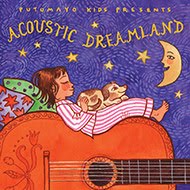 The most recent Putumayo release, Acoustic Dreamland, came in the mail a few weeks back. I've reviewed other Putumayo releases, and it's a pretty safe bet that the songs they gather will be first rate.
Scanning the list of artists, I recognized some heavy hitters (like Frances England and Elizabeth Mitchell), but what made me stop and take notice was a familiar name I hadn't heard in 15 years or so...
My freshman year at Bates college in Lewiston ME, was during the heyday of mid-90's folk rock. Mark Erelli was an alum and a local hero and chances were on a Saturday night you could find Birkenstock wearing teens rocking out to his music somewhere on campus. Naturally I started by listening to his song "My Darling," and it was as good as I remembered him to be.
Though this is an acoustic album, it's not totally stripped down or bare bones. There are some lush arrangements featuring strings and winds (Like Lucy Kaplansky's title track "Dreamland" and the closer by Rick Scott (no, not that one!) "Next Time"). As a collection of "dreamy" night time music, this is a good CD to have on the bedside table.
 The Mike Brady Wrap-up: If you're on a hunt for songs to usher your wee ones into pleasant dreams, I highly recommend Acoustic Dreamland. The performances are strong, the voices sweet and the arrangements are soothing. Sitting here in the afternoon, listening actively to each track, I will say that I've had my fill of breathy vocals, but that's what one might expect from an album of this kind. I appreciate compilations because it allows you to discover new artists who you might not have heard of before (or old ones you haven't heard since your college days).
Kid's Quote of the Day: As we were wrapping things up in music class, Valentina was praising her beautiful singing voice, "My Dad says I have the most beautifulest voice in the world." "You do have a beautiful voice Valentina. I am so glad you helped sing," I said. From the opposite corner of the room I heard, in a wistful almost love sick voice, "And she has a beautiful name!" ~Jackson (age:4)
Friday, March 4, 2011
The Ellen Effect
It seems to happen like clockwork, but every time a daytime talk show host (like Ellen Degeneres) features a young musical prodigy, the switchboards at the schools where I teach lessons light up like Christmas. I call it the "Ellen Effect" (it has a nice ring), when parents start thinking, Maybe my kid is the next... [insert a child-prodigy musician name here].
Sadly, very few people (myself included) are blessed with these amazing talents from such a young age, and those that are often pay a price for being the "wiz-kid." I am a firm believer that anyone can learn to play an instrument, and my livelyhood depends on young minds eager to play and enjoy music.
When the "Ellen Effect" sets in, parents tend to have wildly unrealistic expectations of what their wee one can accomplish. I've consulted with many a mother who is convinced she has a budding Mozart on her hands. To be honest Mozart is "Mozart" (playing concerts at 4, writing symphonies at 6) because this type of talent comes along very rarely (If ever in W.A. Mozart's case). Most of us are destined to play moderately well. The hope is that you enjoy doing it, otherwise what's the point?
After having to talk countless parents down from these delusions of grandeur, I thought I would write a few guide lines and recommendations for parents hoping to start their kids in private music lessons.
Age Appropriate Instruments:
I can't count the number of times a parent with a 3 or 4 year old asks me to teach their child to play guitar. The proliferation of cheap student guitars is a blessing and a curse. I whole-heartedly support buying a preschooler a guitar if it's within your budget (I'd recommend a ukulele instead), but they won't be ready for structured lessons until 7 or 8. Let 'em play and have fun, make a YouTube video of them rocking out, it'll be cute. Here are my recommendations for age appropriate instruments:
Piano- 4 years old is the youngest I will consider teaching. Half hour lessons are just about all they can take, I've even done 15 minute lessons. I wouldn't recommend bumping up to an hour until they are around 10 years old. You certainly don't want to turn them off by over rehearsing them.
Guitar- I have taught kids as young as 7 on the guitar, but it was a challenge. The guitar is exceptionally difficult in the beginning. The challenges you have to overcome just to press a single string down, combined with the pain and blisters can be very discouraging. It's not the way you want to start a child's musical journey. Buy a student sized guitar, and I say go with the steel strings although every music shop in Miami loves to sell people on classical, nylon string guitars.
Ukulele- This is my consolation for parents who just can't take no for an answer when wanting their 4 or 5 y/o to play guitar. The ukulele is smaller, has fewer strings, and because of the tuning has some very simple chords that make starting off easy. There are a lot of ukuleles out there that are really just toys and can't hold a tune, so be careful and ask at your local music store for help in finding a good instrument.
Brass/Woodwinds- I started playing the saxophone when I was 9. Before then I had taken recorder lessons at summer camp. Recorder brings back such vivid memories of elementary school music classes for so many people. It's a great starter instrument, but has it's unique challenges. I have a handful of 5 year old recorder students, any younger than that and those little fingers have a hard time covering the holes. From recorder it's an easy jump to most woodwinds. There's no really warm-up instrument for brass. I recommend 8 or 9 y/o for most orchestral or band instruments.
Violin- I have heard good things about the Suzuki method starting kids off as early as 3. I can't speak from experience, I don't know the method, and though I played violin and cello in 2nd and 3rd grade, I have long since forgotten how to play. It's smaller than guitar so I can see how younger kids could be successful playing.
Practice Makes Perfect:
As a teacher it always ruffles my feathers when a parent expects marked improvement in play when they don't support their child in practicing at home. The real learning happens when the student is left to perfect what has been shown in class. I have come to expect that my students won't practice, I think the alternative is the exception.
The first road block is often a parent who says, "I can't read music, I can help them practice." I like to counter this by saying, "If you expect your 4 y/o to figure this out, why can't you?" The second road block is the battle that ensues when you ask your child to sit down and practice. I always recommend a less is more approach. Practice for short bursts everyday. You'd be amazed at how much progress a child can make with just 5-10 minutes of daily practice. It is much better than expecting your kid to play for an hour the day before the lesson to placate the teacher. They will likely forget everything from this cram session. It's all about repetition. Set an egg timer and give a big hug when they're done.
Finally, if you don't work with your child, or value their learning they will loose interest. If you send them off to their room to practice, they'll be lost. They need a little "Jiminy Cricket" sitting on their shoulder helping them along. The parent who says, "I can't help them. I can't read music," is fated to have a child who grows up to say the same thing. If it's important that your child play music, now's the time to learn with them. Show them that you care enough to learn it too, or there will be a mutiny before too long.
 The Mike Brady Wrap-up: Playing music can bring you a lifetime of joy. Studies show that it improves math scores and increases focus and attentiveness. It's good fine-motor practice for young fingers, but it can be hard to keep up with practice and motivate your child. At the end of the day you have to ask yourself, "What is the goal here?" If you are hoping to breed a child-genius, musical prodigy, you're in for a shock. It takes talent and hard work that 99% of us don't have or won't do. If you want your child to have fun and learn an instrument, find a teacher that is a good match for your child. If they come home saying they don't like the teacher, keep looking. Not everyone is cut out for teaching young kids how to play. I know many, many amazing musicians that make lousy teachers. I often say I spend more time redirecting behavior than actually playing in a 4 y/o lesson, but I expect that. Think about the last time you saw a 4 y/o give their undivided attention to a difficult task for a solid half hour. All in all, every child is different I have been amazed by very young students who take to music like second nature, and I have worked with high schoolers that couldn't put down their iPhone long enough to learn a chord. You get out of music what you put into it.
Kid's Quote of the Day: "Nick, Mr. Nick, what do you do in your real life?" Eryn asked during our afterschool music group. "Ah, this is my real life. What do you mean? What do I do all day while you are at school?" I replied. "Yeah that's what I mean, your real life." ~Eryn (age: 6)
Subscribe to:
Posts (Atom)